OPENING QUESTIONS:
═══════════════════════════
Let's RETAKE our pre test now (notice that I've removed the non-water waves questions).
═══════════════════════════
LEARNING TARGET:
I will take the unit PRE-TEST <again> during today's class
I will work with my team to review water wave characteristics during today's class.
I will work with my team to 'speculate' on the defining characteristics of 'Rogue' Waves during today's class.
WORDS O' THE DAY:
- frequency (waves/second or waves/minute)
- period ("seconds/wave or minutes/wave")
- amplitude (wave height)
- wavelength (distance from crest to crest)
- crest (the highest point of the wave)
- trough (the lowest point of the wave)
- speed = (wavelength x frequency. NOTE: (meters/
wave) x (waves/sec) = meters/sec - Tectonic Plate
- Earthquake Magnitude
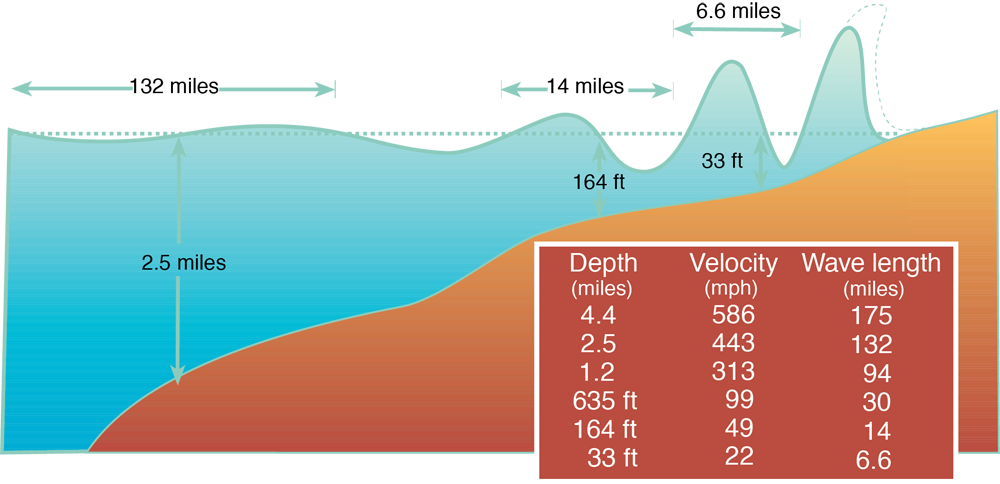
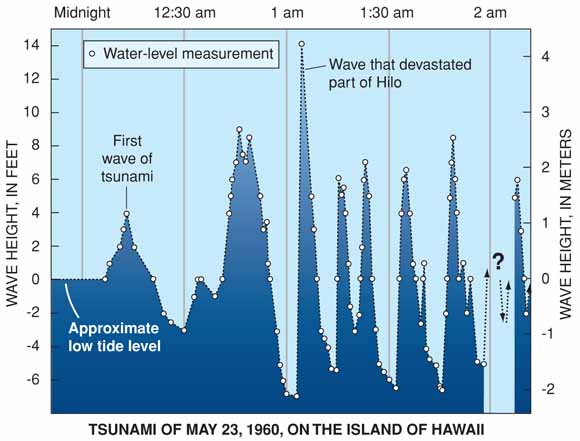
- tsunami (a water wave typically caused by earthquakes and landslides)
- Subduction Zone
CALENDAR: Watch for Observations This Week!
WORK O' THE DAY:
Please grab a table-sized slice of butcher paper and divide it into 4ths (however you like)
Label each section by the type of ocean wave we've discussed -- including Rogue Waves.
Write down sample wave characteristics for each of those that I've required you to learn so far.
We'll do a 'gallery walk' with our team mates to take notes and then review.
The goal here is to get a VERY good idea of the wave characteristics IN CONTEXT with the type of Ocean Wave:
- "Regular" Ocean Waves
- Tsunami
- Megatsunami
- Rogue Waves
Megatsunami revisited:
HERE's the video I've mentiond that has an eye witness account of either the largest or one of the largest waves ever witnessed.
Mauna Loa Megatsunami
Contrast that with a 'regular' tsunami in Japan in 2011